
If you’ve ever visited a doctor, applied for a job, followed a recipe, or completed paperwork, you’ve likely encountered a procedure. But what does procedure mean exactly?
The word appears in healthcare, business, education, science, technology, and even everyday conversations. While its meaning changes slightly depending on the context, the core idea stays the same: a procedure is a series of organized steps that help you complete a task correctly and consistently.
Understanding the meaning of procedure can help you communicate more clearly, follow instructions with confidence, and avoid common misunderstandings. Whether you’re reading a medical report, learning workplace policies, or studying science, knowing what a procedure is makes life much easier.
This guide explains the meaning of procedure in simple language. You’ll also discover how the term is used across different fields, how it differs from similar words like process and policy, and why procedures matter in everyday life.
What Does Procedure Mean?
At its simplest, a procedure is a step-by-step method for completing a specific task. It provides clear instructions that help people perform an activity the same way every time.
Think of a procedure as a roadmap. Instead of guessing what comes next, you follow a defined sequence of actions until you reach the desired result.
Definition: A procedure is an established series of actions or instructions followed to complete a task accurately, safely, and efficiently.
Unlike random actions, procedures are planned. They reduce confusion, improve consistency, and make outcomes more predictable.
Key Characteristics of a Procedure

- Follows a specific order
- Has a clear purpose
- Can be repeated consistently
- Helps reduce mistakes
- Often documented in writing
Everyday Examples of Procedures
| Situation | Procedure |
| Cooking dinner | Follow a recipe step by step. |
| Opening a bank account | Submit documents, verify identity, and sign forms. |
| Airport security | Present ID, scan luggage, and pass through security screening. |
| School admission | Complete the application, provide records, and attend interviews if required. |
| Logging into an online account | Enter your username, password, and verification code. |
Every day, you follow dozens of procedures without even thinking about them.
Procedure Meaning in English (With Examples)
In everyday English, the word procedure refers to an official or accepted way of doing something. Dictionaries commonly define it as a series of actions carried out in a fixed order.
Pronunciation
Procedure is pronounced:
pro-SEE-jer
Word Origin
The word comes from the Latin procedere, meaning to go forward or to advance. Over time, it evolved into the English word “procedure,” describing the steps that move an action toward completion.
Simple Examples
- The company has a procedure for handling customer complaints.
- The teacher explained the laboratory procedure before the experiment began.
- Every airport follows security procedures.
- The nurse carefully described the medical procedure to the patient.
- Employees must follow safety procedures when operating machinery.
Notice that each example involves a structured sequence of actions rather than a single step.
Common Phrases Using Procedure
- Standard procedure
- Emergency procedure
- Safety procedure
- Operating procedure
- Legal procedure
- Medical procedure
- Testing procedure
- Administrative procedure
These phrases appear frequently because procedures help create consistency and accountability.
What Does Procedure Mean in Management?
In management, a procedure is a documented set of instructions that explains how employees should perform specific tasks. It ensures that everyone follows the same method, regardless of who completes the work.
Managers rely on procedures to improve efficiency, maintain quality, and reduce costly mistakes. Instead of leaving tasks to personal interpretation, procedures establish a standard approach.
Why Procedures Matter in Management
Well-designed procedures help organizations:
- Improve productivity
- Maintain consistent quality
- Reduce workplace errors
- Train new employees faster
- Increase accountability
- Support legal and regulatory compliance
- Simplify performance evaluations
Without procedures, every employee might complete the same task differently. That inconsistency often leads to confusion and inefficiency.
Examples of Management Procedures
| Department | Example Procedure |
| Human Resources | Employee onboarding |
| Finance | Expense reimbursement |
| Sales | Processing customer orders |
| Operations | Equipment maintenance |
| Customer Service | Resolving complaints |
| IT | Password reset requests |
Procedures vs. Personal Preference
Imagine two employees preparing payroll. Without a procedure, each person may use different calculations or approval steps. A documented procedure ensures both employees complete payroll accurately and consistently.
That consistency is one reason successful organizations invest significant time in creating clear procedures.
What Does Procedure Mean in Business?
A business procedure is a standardized method for completing routine business activities. Every successful business depends on procedures to deliver reliable products and services.
From answering customer emails to shipping products, procedures guide nearly every business operation.
Common Business Procedures
Businesses typically develop procedures for:
- Hiring employees
- Processing invoices
- Managing inventory
- Handling customer complaints
- Approving purchases
- Delivering products
- Managing payroll
- Responding to emergencies
Each procedure outlines who performs the task, what steps they follow, and when those steps should occur.
Benefits of Business Procedures
Businesses that document procedures often experience:
- Better customer satisfaction
- Faster employee training
- Improved communication
- Higher operational efficiency
- Reduced business risks
- Greater consistency across departments
Example
Suppose an online store receives a product return.
Instead of every employee deciding what to do, the company follows a return procedure:
- Verify the purchase.
- Inspect the returned item.
- Approve or reject the return.
- Process the refund.
- Update inventory records.
- Notify the customer.
Because every employee follows the same instructions, customers receive a consistent experience.
Procedure Meaning in Medical Terms
In healthcare, the term medical procedure refers to any action performed by healthcare professionals to diagnose, treat, monitor, or prevent a medical condition.
Many people hear the word “procedure” and immediately think of surgery. However, not every medical procedure involves an operation.
Medical procedures range from simple blood tests to highly specialized heart surgeries.
Types of Medical Procedures
Healthcare professionals generally classify procedures into several categories.
| Type | Purpose | Examples |
| Diagnostic | Identify a condition | Blood tests, MRI, X-ray, biopsy |
| Therapeutic | Treat an illness | Physical therapy, wound care, dialysis |
| Preventive | Reduce disease risk | Vaccinations, health screenings |
| Surgical | Repair or remove tissue | Appendix removal, knee replacement |
Each type serves a different medical purpose.
Common Medical Procedures
Some procedures people commonly experience include:
- Blood pressure checks
- Blood tests
- Vaccinations
- Colonoscopy
- Endoscopy
- Ultrasound
- CT scan
- MRI scan
- Dental cleaning
- Cataract surgery
Many of these are completed within minutes and require little or no recovery time.
Why Doctors Use the Word “Procedure”
Doctors often use the broader term procedure because it covers many different medical activities.
For example:
- Drawing blood is a procedure.
- Inserting stitches is a procedure.
- Removing a mole is a procedure.
- Performing heart surgery is also a procedure.
The word simply describes a planned medical action performed for a specific healthcare purpose.
Does Procedure Mean Surgery?
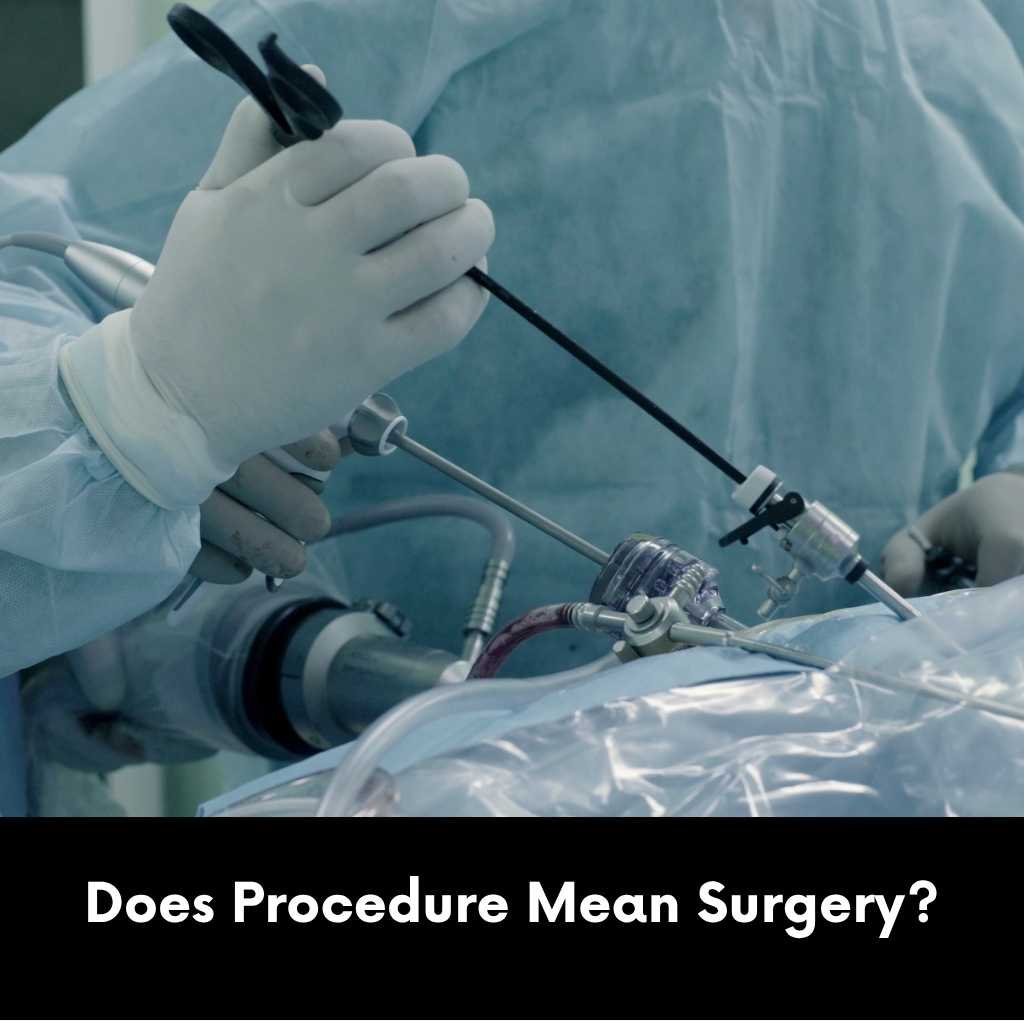
One of the most common questions people ask is whether procedure automatically means surgery.
The answer is no.
While every surgery is considered a medical procedure, not every procedure is surgery.
This distinction is important because many procedures involve little or no cutting, anesthesia, or recovery time.
Surgery vs. Procedure
| Procedure | Surgery |
| Broad term | Specific type of procedure |
| May be non-invasive | Usually invasive |
| Often completed quickly | May require an operating room |
| Recovery may be minimal | Recovery is often longer |
Examples of Non-Surgical Procedures
Many medical procedures don’t involve surgery at all, including:
- Blood tests
- MRI scans
- CT scans
- Ultrasounds
- Allergy testing
- Vaccinations
- Colonoscopies
- Physical therapy sessions
- Dental cleanings
When Does a Procedure Become Surgery?
A procedure is generally considered surgery when it involves making an incision or otherwise operating on the body’s tissues to diagnose, repair, or treat a condition.
Examples include:
- Appendix removal
- Gallbladder surgery
- Hip replacement
- Cataract removal
- Heart bypass surgery
Because the word procedure is broader than surgery, doctors often choose it when discussing treatment options before determining whether an operation is necessary.
Quick Tip: If a healthcare provider says you need a “procedure,” don’t assume you’ll undergo surgery. Ask what the procedure involves, how it’s performed, whether anesthesia is needed, and what recovery you can expect.
What Does “Procedure Done” Mean?
You may have seen the phrase “procedure done” in a hospital discharge summary, insurance paperwork, workplace report, or project update. In simple terms, it means that a planned procedure has been completed successfully or carried out as intended.
The exact meaning depends on the situation. However, the phrase always indicates that someone finished a specific set of actions.
In Healthcare
When a doctor writes “procedure done” in a patient’s medical record, it means the planned medical procedure has been completed. It doesn’t automatically indicate whether the results were normal or abnormal. Those details usually appear elsewhere in the report.
Example:
Procedure done: Colonoscopy completed without complications.
In Business
Businesses also use this phrase to confirm that a required task has been completed.
Examples include:
- Employee onboarding procedure done.
- Annual safety inspection procedure done.
- Inventory audit procedure done.
In Official Documents
Government agencies, schools, and organizations often use similar wording to confirm completion.
For example:
- Registration procedure done.
- Verification procedure done.
- Application procedure completed.
The phrase serves as a simple confirmation that all required steps have been followed.
Procedure Meaning in Science
In science, a procedure is the detailed set of instructions used to perform an experiment or investigation. Every scientific experiment depends on a clear procedure because researchers must repeat the same steps to verify results.
Without a standardized procedure, scientists couldn’t compare findings or reproduce experiments accurately.
Why Scientific Procedures Matter
Scientific procedures help researchers:
- Ensure consistency
- Improve accuracy
- Reduce human error
- Allow experiments to be repeated
- Produce reliable data
Following the exact procedure also helps other scientists confirm whether the original findings are valid.
Typical Parts of a Scientific Procedure
Most experiments include these steps:
| Step | Purpose |
| Gather materials | Prepare equipment and supplies. |
| Follow instructions | Complete each step in order. |
| Record observations | Note what happens during the experiment. |
| Collect data | Measure results objectively. |
| Analyze findings | Interpret the collected information. |
Example
Imagine testing how sunlight affects plant growth.
The procedure may include:
- Plant identical seeds.
- Place them in separate locations.
- Water each plant equally.
- Measure growth every day.
- Record results for two weeks.
By following the same procedure, anyone can repeat the experiment and compare outcomes.
Procedure Meaning in Computer Science

In computer science, a procedure is a block of programming instructions designed to perform a specific task. Instead of rewriting the same code repeatedly, programmers create procedures that can be called whenever needed.
This makes software easier to build, test, and maintain.
What Does a Procedure Do?
A procedure performs a defined operation, such as:
- Printing a report
- Saving a file
- Sending an email
- Calculating payroll
- Validating user input
Whenever the program needs that action, it simply calls the procedure.
Procedure vs. Function
Many beginners confuse procedures with functions because they both organize code into reusable sections.
| Procedure | Function |
| Performs an action | Performs an action and returns a value |
| May not produce output | Usually returns a result |
| Used to organize code | Often used in calculations |
Modern programming languages sometimes use different terminology, yet the underlying concept remains similar.
Simple Example
Think of a coffee machine.
Instead of pressing every internal mechanism yourself, you press one button. Behind the scenes, the machine follows a complete procedure to grind beans, heat water, brew coffee, and pour it into your cup.
Programming procedures work in much the same way.
Procedure vs. Process | What’s the Difference?
People often use procedure and process interchangeably, but they aren’t identical.
A process describes the overall journey from start to finish. A procedure explains exactly how to complete one part of that journey.
Quick Comparison
| Feature | Procedure | Process |
| Focus | Specific instructions | Overall workflow |
| Detail | High | Moderate |
| Purpose | Explain how | Explain what happens |
| Flexibility | Usually fixed | May vary |
Example
Consider baking a cake.
The process includes planning, buying ingredients, baking, decorating, and serving.
The procedure explains exactly how to mix ingredients, set the oven temperature, and bake the cake correctly.
Simply put:
- Process = the big picture
- Procedure = the detailed instructions
Both are important, yet they serve different purposes.
Procedure vs. Policy vs. Protocol
These three words often appear together in workplaces, hospitals, and government organizations. Although they’re related, each has a unique meaning.
| Term | Meaning |
| Policy | A rule or guiding principle. |
| Procedure | The specific steps used to follow the policy. |
| Protocol | A formal standard followed in specialized situations, especially healthcare, research, or emergency response. |
Real-Life Example
Imagine a company wants to protect employee data.
- Policy: Protect customer information at all times.
- Procedure: Employees must log in with multi-factor authentication, encrypt files, and lock computers before leaving.
- Protocol: IT follows a documented cybersecurity response plan during a data breach.
Knowing these differences helps employees understand both what they should do and how they should do it.
Common Synonyms and Related Words for Procedure
Depending on the context, several words have meanings similar to procedure.
Common Synonyms
- Method
- Process
- Routine
- Protocol
- Technique
- Practice
- Workflow
- Operation
- System
- Approach
- Sequence
- Instruction
- Guideline
Although these words overlap, they aren’t always interchangeable. For example, a technique focuses on skill while a procedure focuses on ordered steps.
Choosing the right word depends on the situation.
Common Examples of Procedures in Daily Life
Procedures aren’t limited to hospitals or businesses. You probably follow dozens every single day without realizing it.
At Home
- Following a recipe
- Starting a washing machine
- Setting up a Wi-Fi router
- Paying bills online
At School
- Registering for classes
- Taking an exam
- Completing laboratory experiments
- Borrowing books from the library
At Work
- Clocking in
- Requesting vacation leave
- Completing expense reports
- Conducting employee training
While Traveling
- Airport security screening
- Hotel check-in
- Applying for a visa
- Boarding an airplane
Banking
- Opening a checking account
- Depositing money
- Applying for a loan
- Reporting a lost credit card
Each example follows a structured sequence of actions that helps everyone achieve the same outcome efficiently.
Interesting Fact: Many organizations document hundreds or even thousands of procedures to ensure employees perform tasks consistently regardless of location or department.
Why Are Procedures Important?
Procedures may seem routine, yet they play a critical role in nearly every aspect of life.
Clear procedures help people know exactly what to do, reducing uncertainty and improving confidence. They also make organizations more efficient because everyone follows the same proven steps.
Some of the biggest advantages include:
- Improved consistency
- Better quality control
- Increased workplace safety
- Faster employee training
- Fewer costly mistakes
- Greater legal compliance
- Easier problem-solving
- Better customer experiences
Without procedures, businesses, hospitals, schools, and government agencies would struggle to operate effectively.
As the saying goes:
“Consistency creates reliability, and procedures create consistency.”
Frequently Asked Questions
Is a procedure the same as a process?
No. A process describes the overall workflow, while a procedure explains the exact steps needed to complete a specific task within that workflow.
What is the simple meaning of procedure?
A procedure is a series of organized steps that explain how to complete a task correctly and consistently.
Does procedure always mean surgery?
No. Surgery is one type of medical procedure, but many procedures, such as blood tests, MRIs, vaccinations, and physical therapy, are non-surgical.
What is the difference between a procedure and a policy?
A policy states the rules or expectations, while a procedure explains the exact steps needed to follow those rules.
What does procedure mean in business?
In business, a procedure is a documented set of instructions that employees follow to perform routine tasks consistently and efficiently.
Why do organizations create procedures?
Organizations create procedures to improve quality, reduce mistakes, increase safety, simplify training, and ensure everyone follows the same standards.
Conclusion
Understanding what does procedure mean is more valuable than it first appears. Whether you’re visiting a doctor, managing a business, writing computer code, or completing a science experiment, procedures provide a reliable path from start to finish. They remove guesswork, improve consistency, and help people achieve accurate results.
Although the word takes on slightly different meanings across healthcare, management, business, science, and technology, its central idea never changes: a procedure is a structured series of steps designed to accomplish a specific goal. Knowing the difference between procedures, processes, policies, and protocols also helps you communicate more clearly in both professional and everyday settings. The next time you hear someone mention a procedure, you’ll understand that it isn’t just another instruction, it’s a carefully organized method that keeps tasks efficient, safe, and repeatable

George Knight is a passionate writer, thinker, and believer whose words aim to touch hearts and inspire minds. With a deep love for faith, humanity, and purpose, he writes to remind readers that every soul has a story and every journey has meaning.
He is the author of several inspiring books, including “Echoes of Grace“, “The Silent Prayer“, and “Footprints of Faith“, each filled with reflections on hope, love, and divine strength. Through his writing, George seeks to help others find peace in prayer, courage in faith, and light in moments of darkness.
For George, writing isn’t just expression — it’s a prayer in motion, a way to connect with something greater than ourselves. His words encourage readers to pause, breathe, and believe that grace still flows quietly through every chapter of life.