
What does date conferred mean? If you’ve noticed this phrase on your college transcript, diploma, resume template, or a job application, you may wonder what it actually refers to.
While it sounds formal, the meaning is straightforward once you understand how colleges and universities award degrees.
Knowing your date conferred helps you complete applications accurately, avoid mistakes during employer verification, and present your educational credentials with confidence. Whether you’re a recent graduate, changing careers, or updating your resume, this guide explains everything you need to know.
You’ll also learn how the date conferred differs from your graduation date, where to find it, and why employers and licensing organizations care about it.
What Does Date Conferred Mean In College?

The date conferred in college is the official date your school awards your degree after confirming that you have completed all academic requirements. This date may not be the same as your graduation ceremony because many colleges hold commencement events before or after degrees are officially granted. Employers, universities, and licensing organizations often ask for the date conferred when verifying your education. You can usually find it on your official transcript or diploma. Knowing your date conferred helps you complete job applications and educational forms accurately.
Conferral Date Vs Graduation Date
The conferral date is the official date your college awards your degree, while the graduation date often refers to the ceremony where students celebrate their achievement. In many cases, these dates are the same, but they can also be weeks or even months apart. Employers and institutions usually prefer the conferral date because it confirms when your degree was officially earned. The graduation ceremony is symbolic, whereas the conferral date is the legally recognized academic milestone. Always check which date a form is requesting before submitting your information.
Degree Conferred Vs Received Meaning
A degree conferred means your college has officially awarded your academic degree after verifying that all graduation requirements have been met. A degree received simply means you have obtained or earned the degree, often referring to receiving the diploma itself. Although these terms are commonly used interchangeably, “degree conferred” is the more formal expression found on transcripts and official records. Employers and educational institutions may specifically ask for the degree conferral details. Understanding the difference helps you complete applications correctly and avoid confusion.
Date Conferred Or Expected High School
If you have already finished high school, enter the date conferred shown on your diploma or transcript. If you are still enrolled, provide your expected graduation or conferral date instead. Many applications use the phrase “date conferred or expected” to accommodate both current students and graduates. Your expected date is an estimate based on your school’s academic calendar. If your graduation timeline changes, be sure to update this information wherever required. Using the correct date ensures your educational records remain accurate.
How To Find Date Degree Conferred
You can find your degree conferred date by checking your official college transcript, diploma, or student portal. Most universities display the conferral date in the academic records section after your degree has been awarded. If you cannot locate it, contact your school’s registrar’s office for assistance. They can confirm the exact date your degree was officially granted. This information is often required for employment, graduate school admissions, and professional licensing applications. Always use the official conferral date instead of estimating it.
Degree Conferred Example

A simple degree conferred example is: Bachelor of Science in Computer Science – Degree Conferred: May 15, 2025. This format shows both the type of degree and the official date it was awarded by the institution. You may see similar wording on college transcripts, diplomas, or job applications. Including the correct conferral date helps verify your educational qualifications. Always copy the information exactly as it appears on your official academic records. This prevents errors during background or education verification.
Date Conferred Or Expected College
The phrase date conferred or expected asks whether your college degree has already been officially awarded or is still pending. Graduates should enter the official conferral date listed on their transcript or diploma. Current students should provide their expected conferral date based on their planned graduation term. This information is commonly requested on job, scholarship, and graduate school applications. Be sure the date reflects your institution’s official academic schedule. Updating it if your graduation is delayed is also important.
What Does Conferred Degree Mean?
A conferred degree means a college or university has officially granted your academic qualification after confirming that you completed all required coursework and other graduation requirements. Once your degree is conferred, you are recognized as an official graduate of the institution. This status is recorded on your transcript and often appears on your diploma. A conferred degree is the credential employers and educational institutions use for verification. It confirms that your degree has been formally awarded, not just completed through coursework.
What Does Date Conferred Mean?
The date conferred is the official date an educational institution awards your degree after confirming that you have completed every academic requirement. In simple terms, it is the day your college or university legally recognizes that you have earned your degree.
Many people assume this date is the same as graduation day. In reality, that’s not always true. You might finish your classes in May, attend a commencement ceremony a week later, and receive a degree with a date conferred that falls several days or even weeks afterward.
Think of it this way:
Completing your coursework qualifies you for a degree. The date conferred is when the university officially grants it.
This date becomes part of your permanent academic record and appears on many official documents used for employment, graduate school admissions, licensing, and credential verification.
What Does “Conferred” Actually Mean?

The word conferred simply means officially granted or awarded.
In higher education, universities confer degrees after verifying that students have:
- Completed all required courses
- Earned enough credit hours
- Met GPA requirements
- Satisfied graduation requirements
- Cleared financial obligations if required
- Received final academic approval
Only after these steps does the institution officially award the degree.
For example:
| Student Milestone | Date |
| Final exams completed | May 8, 2026 |
| Commencement ceremony | May 16, 2026 |
| Degree officially conferred | May 22, 2026 |
Although the student celebrated graduation on May 16, the university didn’t officially award the degree until May 22.
What Is a Date Conferred?
A date conferred serves as legal proof that your degree exists. Employers, universities, government agencies, and licensing boards often rely on this date instead of the graduation ceremony.
Unlike a celebration, the conferral process is administrative. University officials verify every graduate’s academic record before approving degrees.
This process usually involves:
- Department approval
- Degree audit
- Registrar verification
- Faculty approval
- Official university authorization
Only after these reviews does the registrar record the degree in your permanent educational records.
When Is a Degree Officially Conferred?
Every educational institution follows its own academic calendar. Some universities confer degrees immediately after the semester ends. Others wait until all grades become official.
Common conferral periods include:
| Academic Term | Typical Date Conferred |
| Spring Semester | May or June |
| Summer Semester | August |
| Fall Semester | December |
| Winter Session | January |
The exact day depends on your college’s graduation schedule.
Who Determines the Date Conferred?
Students don’t choose this date.
Instead, the registrar’s office records the official conferral date after verifying that every graduation requirement has been met.
Large universities often process thousands of graduating students at once, which explains why the official conferral date sometimes occurs after commencement.
Can Every Student Have a Different Date Conferred?
Usually, students graduating during the same semester receive the same official conferral date.
However, exceptions happen when someone:
- Completes coursework late
- Finishes an internship after graduation
- Resolves missing credits
- Receives delayed grade approvals
- Appeals a graduation requirement
In those cases, the degree may be conferred weeks or even months later.
Date Conferred vs Graduation Date
One of the biggest sources of confusion involves the difference between date conferred and graduation date.
Although people often use these terms interchangeably, they don’t always mean the same thing.
| Date Conferred | Graduation Date |
| Official degree award date | Day people often refer to as graduation |
| Recorded by the university | May refer to the ceremony or completion |
| Used for employer verification | Often used conversationally |
| Appears on academic records | May vary depending on context |
| Used for licensing and credential verification | May simply describe finishing school |
Which Date Should You Use?
If a job application specifically asks for the date conferred, always use the official date listed on your transcript or diploma.
If an application asks for your graduation date, you can usually enter the same month and year unless instructions specify otherwise.
Whenever possible, use the information shown on your official academic records instead of estimating.
Date Conferred vs Commencement
Another common misunderstanding involves commencement.
Commencement is the graduation ceremony where students wear caps and gowns, celebrate with family, and receive ceremonial diploma covers.
However, commencement does not officially award your degree.
Here’s a quick comparison.
| Date Conferred | Commencement |
| Official academic event | Ceremonial celebration |
| Degree legally awarded | Students celebrate achievements |
| Recorded on transcript | Usually not recorded on transcript |
| Used for employment verification | Mostly symbolic |
Imagine a student who completes every course but misses commencement because of illness.
That student still receives a degree because the university confers it officially.
Likewise, a student may attend commencement before final grades are processed. If graduation requirements aren’t met, the university won’t confer the degree until everything is complete.
Date Conferred vs Degree Completion Date
The degree completion date refers to the day you finished your final academic requirement.
The date conferred comes afterward when the university officially approves and awards the degree.
These dates often occur close together but don’t always match.
Consider this example:
| Academic Event | Date |
| Final assignment submitted | May 3 |
| Final grades posted | May 10 |
| Degree requirements verified | May 14 |
| Degree officially conferred | May 21 |
This difference matters during credential verification, especially in regulated professions like healthcare, education, and engineering.
Employers generally trust the official degree conferred date because it confirms that every graduation requirement has been satisfied.
Where Can You Find Your Date Conferred?

Fortunately, finding your date conferred isn’t difficult.
Several official documents include this information.
On Your Academic Transcript
The easiest place to locate your date conferred is your academic transcript.
Most transcripts display:
- Degree earned
- Major
- Graduation honors
- Date conferred
- Academic standing
- Institution name
Because transcripts serve as official educational records, employers frequently request them during background checks.
On Your Diploma
Many diplomas also include the official conferral date.
Depending on the university, you may see wording like:
Degree Conferred: May 15, 2026
or
Awarded this fifteenth day of May, Two Thousand Twenty-Six
Some institutions print only the year while others include the complete date.
Through Your Student Portal
Most colleges now provide digital student portals where graduates can access:
- Official transcripts
- Graduation status
- Degree information
- Academic history
- Digital diplomas
Your education history typically includes the official conferral date.
Contacting the Registrar
If you can’t find your transcript or diploma, contact your university’s registrar.
The registrar can verify:
- Your degree
- Degree completion
- Official conferral date
- Graduation requirements
- Replacement transcripts
Because this office maintains permanent academic records, it serves as the most reliable source for official information.
What Does Date Conferred Mean on a Resume?
Including your date conferred on a resume tells employers exactly when your degree became official.
Although many resumes simply list the graduation year, some employers specifically ask for the degree conferred date during hiring.
For regulated professions or positions requiring a college degree, providing accurate education details demonstrates professionalism and attention to detail.
Hiring managers often compare your resume with your transcript during credential verification. Matching dates reduce delays during the hiring process.
For example, your education section could look like this:
Bachelor of Science in Computer Science
ABC University
Date Conferred: May 2026
This format keeps your resume education section clear, accurate, and easy to verify.
For recent graduates, the education section usually appears near the top of the resume because academic achievements remain one of the strongest qualifications. Mid-career professionals and seasoned employees typically move education below their work experience, while still listing the correct degree and conferral date when requested.
How to List the Date Conferred on a Resume
Your resume education section should present your academic background clearly and professionally. If an employer asks for the date conferred, include the official month and year your degree was awarded instead of estimating or using your commencement date.
For most resumes, listing the month and year is enough. However, some government positions, licensing boards, or academic applications may ask for the complete date exactly as it appears on your transcript.
A simple format works best:
Bachelor of Science in Computer Science
ABC University
Date Conferred: May 2026
If the application doesn’t specifically request the date conferred, you can simply list:
Bachelor of Science in Computer Science
ABC University
Graduated: May 2026
The key is consistency. Use the same format throughout your resume so it remains clean, organized, and easy to read.
Resume Example for Recent Graduates
If you’ve recently finished college, your education is one of your strongest qualifications. Place it near the top of your resume before your work experience.
Example
| Education | |
| Degree | Bachelor of Arts in Psychology |
| University | ABC University |
| Date Conferred | May 2026 |
| GPA | 3.8 (Optional) |
| Honors | Magna Cum Laude |
| Relevant Coursework | Cognitive Psychology, Research Methods, Statistics |
Including honors, scholarships, or academic achievements can strengthen your application when you have limited professional experience.
Resume Example for Mid-Career Professionals
As your career grows, employers pay more attention to your work accomplishments than your education.
In this case, keep your education section brief.
Example
Master of Business Administration
XYZ University
Date Conferred: December 2020
There’s usually no need to include your GPA, coursework, or extracurricular activities unless they’re directly relevant to the position.
Resume Example for Career Changers
If you’re moving into a new industry, your education may become important again.
For example, someone transitioning from retail management into software development should highlight a newly earned degree or certification.
Bachelor of Science in Computer Science
ABC University
Date Conferred: May 2025
Adding relevant certifications beneath your degree can further strengthen your qualifications.
Resume Example with Multiple Degrees
If you’ve earned more than one degree, list them in reverse chronological order.
For example:
Master of Science in Data Science
XYZ University
Date Conferred: May 2025
Bachelor of Science in Mathematics
ABC University
Date Conferred: May 2021
This format improves resume readability and helps hiring managers quickly understand your educational background.
Where Should You Put the Date Conferred in the Education Section?
Your education section should be easy to scan. Recruiters often spend only a few seconds reviewing each resume, so clear formatting makes a strong first impression.
Most professionals place the date conferred directly below the degree or on the same line as the institution.
For example:
| Recommended Format |
| Bachelor of Science in Nursing |
| ABC University |
| Date Conferred: May 2026 |
If you’re using a two-column resume, you can align the date on the right side.
Example:
| Education | Date |
| Bachelor of Science, ABC University | May 2026 |
Whichever format you choose, keep it consistent across all educational entries.
Resume Formatting Best Practices
To create a polished and professional resume education section, follow these tips:
- List degrees in reverse chronological order.
- Use the official degree title.
- Include the educational institution’s full name.
- Use the official date conferred when requested.
- Maintain consistent date formatting throughout the resume.
- Avoid abbreviations unless they’re widely recognized.
- Keep spacing and font styles consistent.
A well-organized education section not only looks professional but also makes educational verification faster for recruiters.
Date Conferred on Job Applications
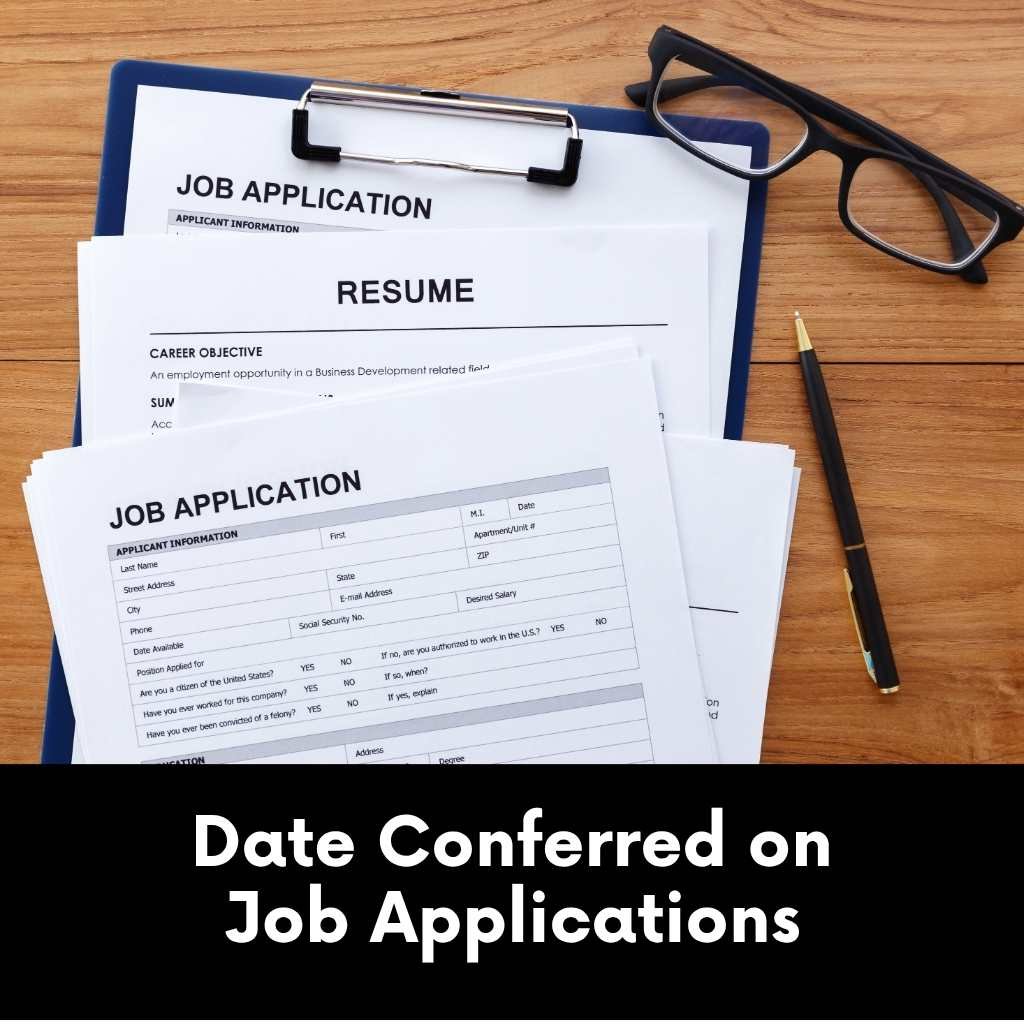
Many online job applications ask for your date conferred instead of your graduation date.
This helps employers verify that you’ve officially earned the degree required for the position.
When completing an application:
- Enter the exact month and year listed on your transcript.
- Double-check spelling of your university.
- Use the official degree title.
- Avoid estimating dates.
- Match the information shown on your resume.
Providing accurate education details reduces delays during the hiring process and demonstrates attention to detail.
Why Employers Ask for the Date Conferred
Employers don’t request this information out of curiosity. They use it to confirm that applicants meet the educational requirements for a position.
For example, if a role requires a bachelor’s degree before June 2025, the employer needs proof that your degree was officially awarded before that deadline.
The date conferred provides that proof.
It also helps verify:
- Educational credentials
- Degree completion
- Academic qualifications
- Professional qualifications
- Employment eligibility
For regulated industries such as healthcare, education, engineering, finance, and government, this information may be mandatory.
How Hiring Managers Use This Information
Hiring managers compare the education section of your resume with other official documents.
These may include:
- Academic transcripts
- Degree verification reports
- Background check results
- Professional licensing records
- Certification databases
If the dates don’t match, recruiters may contact your university for clarification before moving forward.
Although many discrepancies are simple mistakes, correcting them can delay the hiring process.
Why the Date Conferred Matters During Employer Verification
Today’s employers routinely perform credential verification before making a final hiring decision.
Background screening companies contact colleges and universities to confirm that applicants actually earned the degrees listed on their resumes.
During this process, they typically verify:
| Information Verified | Purpose |
| Degree earned | Confirms qualification |
| Major or field of study | Verifies academic background |
| Educational institution | Confirms attendance |
| Date conferred | Verifies official degree award |
| Graduation status | Confirms degree completion |
If everything matches, verification usually finishes quickly.
If information differs, employers may ask applicants to submit an official transcript or proof of completion before continuing.
For this reason, never guess your date conferred. Always use the official date recorded by your college or university.
Does the Date Conferred Appear on Your Transcript?
Yes. In most cases, your academic transcript includes the official date conferred because it serves as your permanent educational record.
A transcript often lists:
- Student name
- University name
- Degree earned
- Major and minor
- Academic honors
- Credit hours completed
- Final GPA
- Date Conferred
Employers, graduate schools, and licensing agencies generally consider transcripts the most reliable source for verifying academic credentials.
What If Your Transcript Doesn’t Show the Date?
Although uncommon, some institutions use different transcript formats.
If your transcript doesn’t clearly display the conferral date, don’t assume it’s missing permanently.
You can:
- Request an updated official transcript.
- Contact the registrar’s office.
- Ask for an official degree verification letter.
- Download a digital degree verification if your university offers one.
These documents provide the same level of authenticity and are widely accepted during qualification verification.
Does the Date Conferred Appear on Your Diploma?
In many cases, yes.
Most universities print either the full date conferred or the year the degree was officially awarded.
A diploma generally includes:
- Student’s full name
- Degree title
- Educational institution
- Official signatures
- University seal
- Date awarded or date conferred
However, diploma designs vary by institution. Some display only the graduation year, while others include the exact day, month, and year.
If your diploma doesn’t show the complete date, your transcript remains the official document for employment, graduate admissions, and credential verification.
What Does Date Conferred Mean for Professional Certifications?
The term date conferred isn’t limited to college degrees. Some professional certifications, graduate programs, and specialized training providers also use it to indicate the official date a credential was awarded.
However, many certification organizations use terms such as certification date, credential awarded, or issue date instead of date conferred. Regardless of the wording, the purpose is the same—it identifies when you officially earned the qualification.
Examples include:
- Certified Information Systems Security Professional (CISSP)
- Certified Public Accountant (CPA)
- Professional Engineer (PE)
- Teaching certifications
- Nursing certifications
- Project Management Professional (PMP)
- Human Resources certifications
When updating your resume or LinkedIn profile, always use the official award date listed by the issuing organization.
Certification Date vs. Date Conferred
Although they often serve the same purpose, these terms aren’t always interchangeable.
| Date Conferred | Certification Date |
| Common for colleges and universities | Common for certification providers |
| Indicates a degree was officially awarded | Indicates a certification became active |
| Appears on academic records | Appears on certification records |
| Used during educational verification | Used during professional credential verification |
Review the wording used by your institution before completing job applications or licensing paperwork.
Why the Date Conferred Matters for Licensing and Professional Careers
For many careers, earning a degree is only the first step. Employers, licensing boards, and government agencies often require proof that your degree was officially awarded before you can begin practicing.
This is especially important in regulated industries where education directly affects public safety.
Examples include:
- Healthcare
- Nursing
- Pharmacy
- Physical Therapy
- Teaching
- Engineering
- Law
- Public Accounting
For example, a nursing graduate may finish clinical rotations in May but cannot apply for state licensure until the university officially confers the nursing degree.
Likewise, teaching candidates often need proof of their degree conferred before applying for certification or employment with a school district.
In these situations, the official conferral date becomes more than just an administrative detail—it determines when you’re eligible to move forward in your career.
Common Mistakes People Make About the Date Conferred
Many graduates unintentionally use the wrong date when completing resumes or employment applications. These errors are usually minor, but they can create unnecessary delays during credential verification.
Here are the most common mistakes to avoid.
Using the Commencement Date
Your commencement ceremony celebrates your achievement, but it doesn’t necessarily represent the official degree award date.
Always verify the date listed on your transcript.
Guessing the Date
Some graduates remember the month but not the exact date. Guessing can create inconsistencies between your resume and official records.
Instead, confirm the information through your university.
Confusing Degree Completion with Degree Conferral
Finishing your last exam doesn’t automatically mean your degree has been awarded.
Universities still need to:
- Review your academic record.
- Confirm graduation requirements.
- Approve your degree.
- Record the official conferral.
Using the Transcript Issue Date
A transcript may be printed months or years after graduation.
The issue date simply shows when the document was generated—not when your degree was awarded.
Listing Different Dates on Different Documents
Your resume, job application, LinkedIn profile, and professional portfolio should all contain consistent education information.
Small differences can raise questions during a background check, even when the mistake is accidental.
What If You Haven’t Graduated Yet?
Many students begin applying for jobs before completing their final semester.
If your degree hasn’t been awarded yet, don’t list a date conferred because one doesn’t exist.
Instead, clearly indicate your expected completion.
Examples include:
- Expected Graduation: December 2026
- Degree in Progress
- Expected Degree Completion: Spring 2027
This tells employers you’re actively pursuing the qualification without implying you’ve already earned it.
Honesty is always the best approach. Claiming a degree before it’s officially awarded can damage your credibility if an employer performs an educational verification.
What If Your Degree Was Conferred Late?

Sometimes a university delays conferring a degree even after a student finishes coursework.
Common reasons include:
- Missing final grades
- Incomplete internship requirements
- Outstanding tuition balances
- Administrative processing delays
- Graduation application issues
- Degree audit corrections
In most cases, the delay doesn’t mean you failed to graduate. It simply means the university hasn’t completed its review process.
Once every requirement is satisfied, the registrar updates your permanent academic record with the official date conferred.
If you’re applying for a job during this period, ask your university for a letter confirming you’ve completed your degree requirements while the official conferral is pending.
How Universities Determine the Official Date Conferred
Behind every degree is a detailed review process designed to protect the integrity of academic credentials.
Although procedures vary among institutions, most universities follow a similar sequence.
- Final grades are submitted.
- Departments review graduation requirements.
- A degree audit confirms completed coursework.
- The registrar verifies all academic records.
- University officials approve eligible graduates.
- Degrees are officially conferred.
- Academic transcripts are updated.
- Diplomas are printed and distributed.
This process helps ensure that every graduate has fulfilled the institution’s academic standards before receiving a degree.
Because of these verification steps, your date conferred represents the official completion of your educational journey rather than the day you finished your last class.
Can You Change Your Date Conferred?
In most cases, no.
The official date conferred becomes part of your permanent educational record and cannot be changed simply because you prefer another date.
However, corrections may be possible if your university made an administrative error.
For example, a registrar may update your academic record if:
- The wrong degree was recorded.
- A clerical mistake affected your transcript.
- Required coursework wasn’t properly documented.
- An approved graduation appeal changed your eligibility.
If you believe there’s an error, contact the registrar’s office as soon as possible. They can explain the institution’s correction process and tell you what supporting documents are required.
Real Examples of Date Conferred
Looking at real-world examples makes the concept much easier to understand.
Bachelor’s Degree Example
| Degree | Bachelor of Science in Computer Science |
| Institution | ABC University |
| Coursework Completed | May 8, 2026 |
| Commencement Ceremony | May 15, 2026 |
| Date Conferred | May 20, 2026 |
Although the student celebrated graduation on May 15, the university officially awarded the degree on May 20.
Master’s Degree Example
A graduate completes all MBA requirements in December. After faculty approval and a successful degree audit, the university confers the degree on December 18. That date appears on the transcript and serves as the official award date for employment and doctoral program applications.
Doctoral Degree Example
A doctoral candidate successfully defends a dissertation in April but must submit final revisions before graduation. The university approves the revised dissertation in May and officially confers the doctoral degree at the end of the semester. Even though the dissertation defense occurred earlier, the conferral date remains the official credential date.
Professional Certification Example
An IT professional completes every requirement for the Certified Information Systems Security Professional (CISSP) certification on August 10. After the certification body verifies the application and issues the credential, the official certification date becomes August 24. This is the date the professional should list on resumes, certification profiles, and employment applications.
Frequently Asked Questions
Is the date conferred the same as the graduation date?
No. The date conferred is when your degree is officially awarded, while the graduation date may refer to your commencement ceremony.
Do employers verify the date conferred?
Yes. Many employers verify your degree, educational institution, and date conferred during background checks.
Where can I find my date conferred?
You can find it on your academic transcript, diploma, student portal, or by contacting your registrar’s office.
Can I use my commencement date instead?
No. If an application asks for the date conferred, always use the official date listed on your academic records.
What if I haven’t graduated yet?
List Expected Graduation or Degree in Progress instead of a date conferred until your degree is officially awarded.
Conclusion
Understanding what does date conferred mean helps you present your education accurately and confidently. It represents the official date your educational institution awards your degree after confirming you’ve completed every academic requirement. Although it may differ from your graduation ceremony or degree completion date, it’s the date employers, graduate schools, and licensing boards rely on during credential verification.
Always use the official date conferred shown on your transcript or diploma when updating your resume education section or completing a job application. Taking a few moments to verify this information can prevent unnecessary delays and demonstrate professionalism. Whether you’re a recent graduate or an experienced professional, understanding the date conferred meaning ensures your educational credentials remain accurate, credible, and ready for every career opportunity.

Ethan Langford is a passionate writer, storyteller, and believer in the power of words to heal, inspire, and connect hearts. Through his writing, Ethan explores the beauty of faith, hope, and human emotions that unite us all.
He is the author of “Whispers Beneath the Moonlight”, “The Heart That Still Believes” and “Letters from the Quiet Soul”, books that gently touch the reader’s spirit and remind us that even in silence, grace is speaking.
Ethan’s work reflects a quiet prayer woven into every line — a hope that his words may bring light to those walking through their own shadows. Whether he writes about love, loss, or faith, his stories carry the warmth of reflection and the comfort of divine presence.
“May every word I write be a small prayer whispered into the world.” — Ethan Langford